
Have you ever wondered whether your weight is healthy for your height? You are not alone. Millions of people around the world ask this question every day. One of the simplest and most widely used tools to answer it is the Body Mass Index, commonly known as BMI.
BMI gives you a quick snapshot of where your body weight stands in relation to your height. Whether you are trying to lose weight, maintain a healthy lifestyle, or just curious about your health status, knowing how to calculate your BMI is an essential first step.
In this guide, you will learn exactly what BMI is, why it matters, how to calculate it using both metric and imperial measurements, and how to interpret your results accurately.
What Is BMI?
BMI stands for Body Mass Index. It is a numerical value derived from a person’s weight and height. The concept was developed by Belgian mathematician Adolphe Quetelet in the 19th century and has since become a standard screening tool used by doctors, nutritionists, and health professionals worldwide.
In simple terms, BMI is a measure of body fatness based on your height and weight. It does not directly measure body fat, but it provides a reliable indicator of body composition for most adults. The higher your BMI, the more likely you are to carry excess body fat — and vice versa.
BMI applies to adult men and women of all body types and ages (with some exceptions for children and the elderly, which we will cover later).
Why Is BMI Important?
BMI is one of the most commonly used tools in preventive healthcare. Here is why it matters:
- It helps doctors screen patients for potential weight-related health conditions.
- It identifies whether a person is underweight, normal weight, overweight, or obese.
- It helps track weight changes over time as part of a health or fitness program.
- It is used in large-scale public health studies to assess population-level obesity trends.
- It is a quick, non-invasive, and cost-free measurement that anyone can do at home.
However, it is important to note that BMI has limitations. It does not distinguish between muscle and fat mass, meaning a highly muscular athlete may have a high BMI without being unhealthy. It should always be used alongside other health indicators for a complete picture.
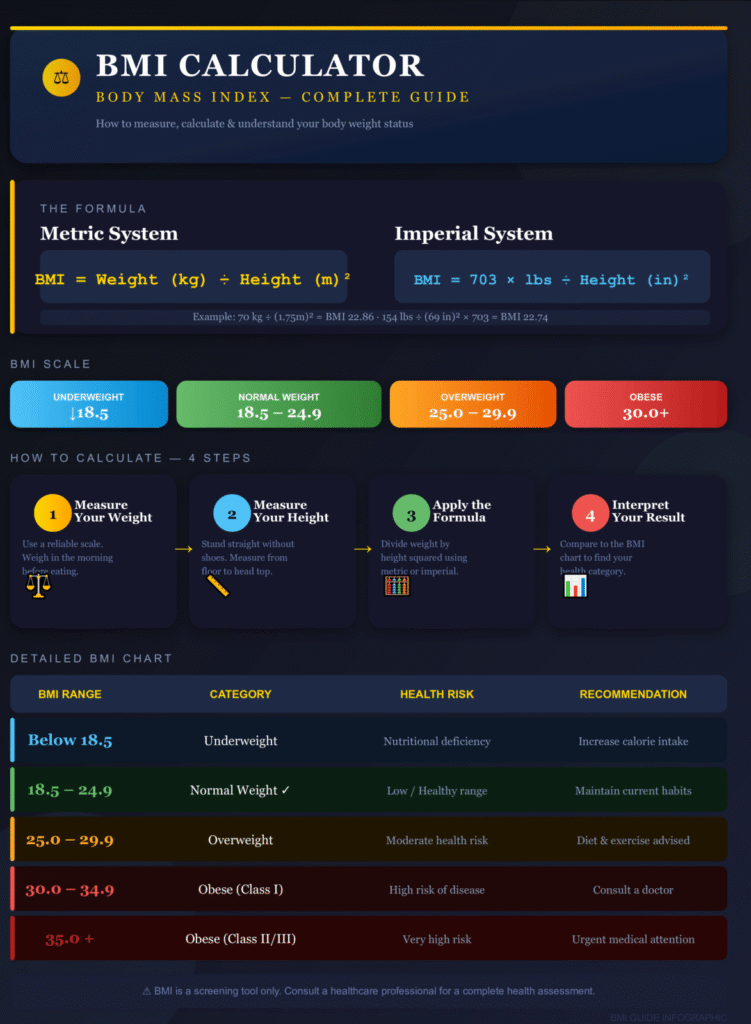
BMI Formula
There are two versions of the BMI formula — one for the metric system (kilograms and meters) and one for the imperial system (pounds and inches).
Metric Formula
BMI = Weight (kg) ÷ Height (m)²
For example: If you weigh 70 kg and are 1.75 meters tall:
BMI = 70 ÷ (1.75 × 1.75) = 70 ÷ 3.0625 = 22.86
Imperial Formula
BMI = 703 × Weight (lbs) ÷ Height (inches)²
For example: If you weigh 154 lbs and are 69 inches (5’9″) tall:
BMI = 703 × 154 ÷ (69 × 69) = 108,262 ÷ 4,761 = 22.74
How to Calculate BMI — Step by Step
Follow these four simple steps to calculate your BMI accurately:
Step 1: Measure Your Weight
Use a reliable weighing scale to measure your body weight. For best results, weigh yourself in the morning before eating or drinking, and wear minimal clothing. Record your weight in kilograms (kg) for the metric formula, or in pounds (lbs) for the imperial formula.
Step 2: Measure Your Height
Stand straight against a wall without shoes. Use a measuring tape or stadiometer to measure from the floor to the top of your head. Record your height in meters (m) for metric, or in inches (in) for imperial. To convert feet and inches to total inches, multiply feet by 12 and add remaining inches (e.g., 5’9″ = 69 inches).
Step 3: Apply the Formula
Once you have your measurements, plug them into the appropriate formula:
- Metric: Divide your weight in kg by the square of your height in meters.
- Imperial: Multiply 703 by your weight in lbs, then divide by the square of your height in inches.
Step 4: Interpret Your Result
Compare your calculated BMI number against the standard BMI categories (see the chart in the next section). This will tell you whether you fall in the underweight, normal, overweight, or obese range.
BMI Categories Chart
Use this chart to interpret your BMI result:
| BMI Range | Category | Health Risk |
| Below 18.5 | Underweight | Nutritional deficiency |
| 18.5 – 24.9 | Normal Weight | Low / Healthy |
| 25.0 – 29.9 | Overweight | Moderate risk |
| 30.0 – 34.9 | Obese (Class I) | High risk |
| 35.0 and above | Obese (Class II/III) | Very high risk |
Note: These categories are based on WHO and CDC guidelines for adults aged 20 and above. For children and teens, BMI is interpreted differently using age- and sex-specific percentile charts.
How to Calculate BMI for Different Groups
BMI for Adults (Men and Women)
The standard BMI formula and chart above apply to all adults aged 20 and older, regardless of gender. While men and women may differ in body fat distribution, the BMI scale does not vary by sex for adults.
BMI for Children and Teenagers
For children and teens aged 2 to 19, BMI is calculated the same way but interpreted differently. Instead of fixed categories, BMI is compared against age- and gender-specific growth charts developed by the CDC. The result is expressed as a percentile ranking:
- Below 5th percentile: Underweight
- 5th to 84th percentile: Healthy weight
- 85th to 94th percentile: Overweight
- 95th percentile and above: Obese
BMI for Older Adults (60+)
Research suggests that the standard BMI categories may not be fully accurate for older adults. Seniors naturally lose muscle mass and may have a “normal” BMI while still carrying excess fat. Some health professionals recommend slightly higher BMI thresholds for people over 65. Always consult a doctor for personalized assessment.
Limitations of BMI
While BMI is a useful screening tool, it is not without flaws. Here are the key limitations you should be aware of:
- Does not measure body fat directly — it cannot distinguish between fat, muscle, or bone mass.
- May misclassify athletes — bodybuilders or highly muscular individuals may have a high BMI but low body fat.
- Ethnicity differences — research shows that people of Asian descent may face health risks at lower BMI thresholds.
- Does not account for fat distribution — where fat is stored (e.g., around the abdomen) matters as much as total fat.
- Not ideal for the elderly — older adults often have lower muscle mass which can skew results.
Because of these limitations, BMI should always be used in combination with other measurements such as:
- Waist circumference
- Waist-to-hip ratio
- Body fat percentage (measured by DEXA scan, skinfold calipers, or bioelectrical impedance)
- Blood tests and cholesterol levels
Tools to Calculate BMI Easily
You do not have to do the math manually every time. Here are several convenient tools:
- Online BMI Calculators: Websites like the CDC (cdc.gov) and WHO offer free, instant BMI calculators where you just enter your height and weight.
- Smartphone Apps: Apps like MyFitnessPal, Lose It!, and Google Fit allow you to track BMI alongside diet and exercise data.
- Smartwatches and Fitness Trackers: Devices like Fitbit, Apple Watch, and Garmin can estimate body composition metrics, including BMI approximations.
- Doctor’s Office: Your physician or nurse can calculate and interpret your BMI during any routine checkup.
Frequently Asked Questions (FAQs)
What is a healthy BMI?
A BMI between 18.5 and 24.9 is considered healthy for most adults. This range is associated with the lowest risk of weight-related health problems.
Is BMI the same for men and women?
Yes. The standard BMI formula and categories are the same for both men and women aged 20 and above. However, women typically have a higher percentage of body fat at the same BMI compared to men, which is a known limitation of the tool.
How often should I check my BMI?
For most healthy adults, checking BMI once or twice a year is sufficient. If you are actively trying to lose or gain weight, checking monthly can help you track progress. Always pair BMI checks with other health metrics for a complete picture.
Can BMI be inaccurate?
Yes, BMI can be inaccurate in certain situations — particularly for athletes, bodybuilders, pregnant women, the elderly, and certain ethnic groups. It is a screening tool, not a diagnostic one, and should be interpreted by a healthcare professional.
What should I do if my BMI is too high or too low?
If your BMI falls outside the normal range, the first step is to consult a doctor or registered dietitian. They can assess your overall health, lifestyle, and diet to recommend a personalized action plan. Never make drastic dietary changes without professional guidance.
Conclusion
Calculating your BMI is a simple and powerful way to get a quick overview of your weight status. By using the metric formula (weight ÷ height²) or the imperial formula (703 × weight ÷ height²), you can determine whether you fall in the underweight, normal, overweight, or obese category.
However, remember that BMI is just one piece of the puzzle. For a truly comprehensive understanding of your health, combine BMI with other measurements, a balanced diet, regular physical activity, and routine medical checkups.